Elma. Red Cross Blood Drive at the Grange.
The Woman couldn't get my blood to flow through the needle. I looked over and saw her wiggling a size 16 or 18 needle and fixing to push it deeper.
I said, "That hurts. I don't feel confident about this. Can you please get some help?"
She called. Yuriko came. Woman said, "we need to go deeper."
I said, "Oh, no you don't."
She then said to Yuriko, " the vein moved."
I thought, no, it didn't move, you didn't properly anchor it. You didn't focus on doing this. Your mind was off somewhere else.
I said to Yuriko, "I need you to do this."
I have veins like garden hoses. Yuriko did not miss. I thanked her.
They took two units of blood, re-infusing my plasma after each unit. Two Tums calcium tabs before the re-infusions couldn't keep the citrate from chelating enough of my serum Ca making my lips tingle.
Tuesday, August 5, 2014

Frying Pan Lake Loop hike
Frying Pan Lake Loop
In their guide 100 hikes in the Washington's South Cascades and Olympics, Manning and Spring accurately described this trip in the William O. Douglas Wilderness Area with at least two flaws: too many bugs & parts of the trails almost destroyed by horse usage.
I recommend this trip for September instead, after a good freeze, when most of the bugs will be dead, dead, dead, if you go at all. Trail switchbacks are moderately graded with few steep rises and you really can't "fall off" the trail anywhere; Once you've reached Penoyer Lake or Jug Lake the trail rolls along mildly with many level sections. The whole loop is less than 15 miles, which is great as a day hike or as an intro to overnight camping for newbies. I spent two nights out because I didn't need to go home.
The bugs gave me hell shortly after I set out at ~5:30 p.m. Saturday August 2. With a 22 lb pack and going uphill, I couldn't walk fast enough to keep them from attacking. They knew my blood tasted better than that of anyone else's on the trail. Pieces of swatted, dead bugs mixed with sweat, dust and insect repellent made for a dirty job. If you plan to camp at Penoyer Lake (a big pond, really, and bugged), you'll want to fill your water bottles by the fifth creek up from the trailhead, as you may dislike the brackish water at Penoyer, where you'll wet your shoes or feet getting to water deep enough to dip your bottle. I arrived early enough at Penoyer to set up camp and my bear bagging line (PCT method) and also cook dinner. I hadn't enough decent water for breakfast, which I deferred until I arrived at Snow Lake. Snow Lake's camp site was much more open than Penoyer, if you can get to the trailhead early enough (maybe 3-4 hours)--as for bugs, a couple camped there wore head nets. Frying Pan Lake had an inch of organic matter covering fist sized rocks which made for difficult barefoot walking, 4" swimming worms (leeches?) and lots of organic matter in the water whether filled from the surface or below the surface.
Jug Lake had much better water quality. At Jug Lake the fish worked hard to reduce the bug population, but many bugs survived both morning and evening feeds--during bug season, one would want to go for the fishing. No bears, no deer appeared during my visit. I hung my food 10' up & 6' out, so can't comment on rodents.

At Jug Lake, the penny stove 2.0 didn't prime--I blew out the puny flame, poured more alcohol near the base of the stove, re-lit and it behaved. Not expensive or heavy like an MSR liquid stove, but not as foolproof as a cat stove.
I washed my hair with the soap I had, diluted dish detergent, which is just wrong. I couldn't fall asleep the 2nd night--I wasn't tired enough or I just couldn't find the sweet spot in the hammock for getting to sleep. I felt like I was awake all the time, sitting up or lying down from 9 p.m. to 3:30 a.m., pinching or scratching some bug bites or scratching my head. Finally, I found the sweet spot and slept soundly until ~7:30.
Mosquito Bites
1. left arm/hand 21 bites
2. Right arm/hand 17
3. Head/neck 7
4. Shoulders and back 40 bites right through my shirt
5. legs 6
I resolved to make a soup of permethrin to soak my clothes to keep the girls away. Note to self on bug repellent: take liquid repellent. The solid stick, while great for coating my hair and head, can't cover like liquid.
Food: I took 3 lb and had 1.5 lb after the trip. Walking without snacking likely arose from my subconscious keeping me moving to thwart bugs. Rethinking food: increase the size of the morning and evening meals.
 |
| Trail head selfie |
I recommend this trip for September instead, after a good freeze, when most of the bugs will be dead, dead, dead, if you go at all. Trail switchbacks are moderately graded with few steep rises and you really can't "fall off" the trail anywhere; Once you've reached Penoyer Lake or Jug Lake the trail rolls along mildly with many level sections. The whole loop is less than 15 miles, which is great as a day hike or as an intro to overnight camping for newbies. I spent two nights out because I didn't need to go home.
The bugs gave me hell shortly after I set out at ~5:30 p.m. Saturday August 2. With a 22 lb pack and going uphill, I couldn't walk fast enough to keep them from attacking. They knew my blood tasted better than that of anyone else's on the trail. Pieces of swatted, dead bugs mixed with sweat, dust and insect repellent made for a dirty job. If you plan to camp at Penoyer Lake (a big pond, really, and bugged), you'll want to fill your water bottles by the fifth creek up from the trailhead, as you may dislike the brackish water at Penoyer, where you'll wet your shoes or feet getting to water deep enough to dip your bottle. I arrived early enough at Penoyer to set up camp and my bear bagging line (PCT method) and also cook dinner. I hadn't enough decent water for breakfast, which I deferred until I arrived at Snow Lake. Snow Lake's camp site was much more open than Penoyer, if you can get to the trailhead early enough (maybe 3-4 hours)--as for bugs, a couple camped there wore head nets. Frying Pan Lake had an inch of organic matter covering fist sized rocks which made for difficult barefoot walking, 4" swimming worms (leeches?) and lots of organic matter in the water whether filled from the surface or below the surface.
 |
| Frying Pan Lake. Nice puffy clouds! |
Jug Lake had much better water quality. At Jug Lake the fish worked hard to reduce the bug population, but many bugs survived both morning and evening feeds--during bug season, one would want to go for the fishing. No bears, no deer appeared during my visit. I hung my food 10' up & 6' out, so can't comment on rodents.
At Jug Lake, the penny stove 2.0 didn't prime--I blew out the puny flame, poured more alcohol near the base of the stove, re-lit and it behaved. Not expensive or heavy like an MSR liquid stove, but not as foolproof as a cat stove.
 |
| Food up! |
Mosquito Bites
1. left arm/hand 21 bites
2. Right arm/hand 17
3. Head/neck 7
4. Shoulders and back 40 bites right through my shirt
5. legs 6
I resolved to make a soup of permethrin to soak my clothes to keep the girls away. Note to self on bug repellent: take liquid repellent. The solid stick, while great for coating my hair and head, can't cover like liquid.
Food: I took 3 lb and had 1.5 lb after the trip. Walking without snacking likely arose from my subconscious keeping me moving to thwart bugs. Rethinking food: increase the size of the morning and evening meals.
Monday, August 4, 2014
Enchanted Valley hike
July 9, 2014
John and I set out Monday July 7 at 12 noon. Only for me to remember 1.5 miles in, that I needed to cancel an appointment I'd made for today at 9 a.m. Jon gave me the car key--I trotted down the trail, and motored down towards Quinault. About 10 miles later, I noted a weak but steady cell phone signal over a short strip of road. I turned back a few yards after the signal disappeared and had enough signal to call. I returned to the trailhead about 2:15 p.m. and walked briskly, crossing Pony Bridge, Fire Creek, O'Neill Creek Camp, and Noname Creek. As I approached Pyrite Creek ~10 miles in, I came upon Jon reclining against a tree.
We camped right there.
We entered the Enchanted Valley in the morning, and sat on the porch of the chalet, full sun favoring us.


John and I set out Monday July 7 at 12 noon. Only for me to remember 1.5 miles in, that I needed to cancel an appointment I'd made for today at 9 a.m. Jon gave me the car key--I trotted down the trail, and motored down towards Quinault. About 10 miles later, I noted a weak but steady cell phone signal over a short strip of road. I turned back a few yards after the signal disappeared and had enough signal to call. I returned to the trailhead about 2:15 p.m. and walked briskly, crossing Pony Bridge, Fire Creek, O'Neill Creek Camp, and Noname Creek. As I approached Pyrite Creek ~10 miles in, I came upon Jon reclining against a tree.
We camped right there.
We entered the Enchanted Valley in the morning, and sat on the porch of the chalet, full sun favoring us.
 |
| John sits on the end of the chalet's porch opposite the end that overhangs the river. |
 |
| Our camp sweet camp. |
On the morning we left for home, mist filled the valley.
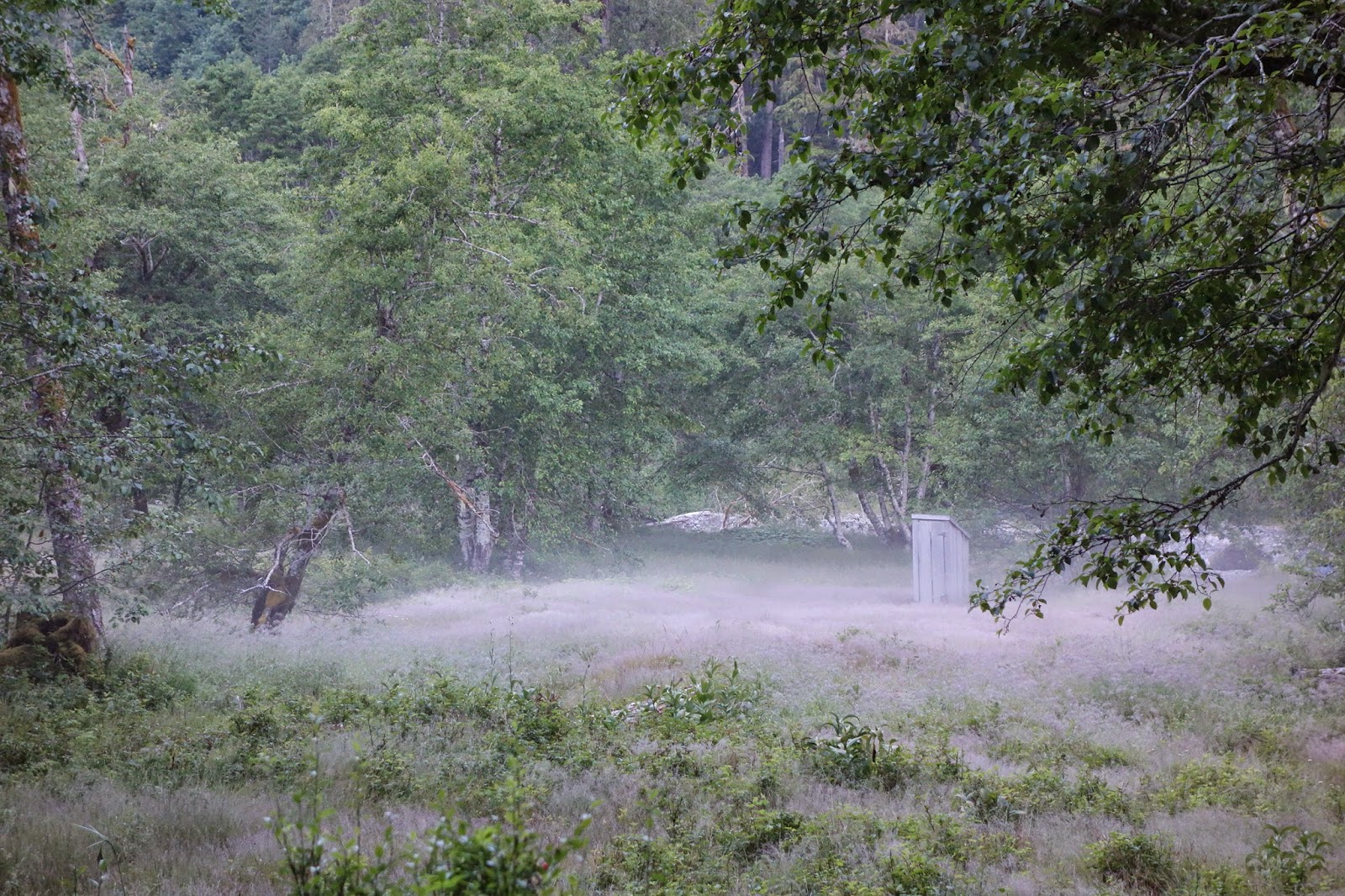 |
| A privy can hardly appear more mystical. Thankfully cameras don't record wicked stench, a surfeit of which the privy enjoyed. |
 | |
|
We took pictures showing how the river's new course had undermined the Enchanted Valley Chalet:
Below: I'm stretching my calf--I'm not doing my wimpy best to tip the chalet into the river.
Uh, this picture shows me stretching my quads and holding the post for balance, not pushing the chalet, right?
 |
| Starting the day right. |
Friday, June 13, 2014
Those other women in the pool
The 89 degree pool at the fitness center where my mom lives has an aqua-cise class 2x a week. Yes, 89 degrees. I like it about 81 or so for lap swimming, but it's free for guests and the pool has an anti wave lane divider. Most of the pool's users really don't swim, or move. Why they don't confine themselves to the spa, I can't know.
Women began showing up near the end of my lap swimming hour one day. Plump, but not morbidly so, and no doubt tender, juicy, and marbled. Foam noodles, flotation booties and arm thingies came out of the instructor's bag. I expected a lively sound program and an active session of arm waving and dancing sideways across the pool. The instructor and her four students entered the water, commenting on how cold the water felt and floated, moving slowly hither and thither. Maybe they were just warming up. Twenty minutes later, the same lethargic movement. So much for aqua-cise. I figured that I was missing something.
Minutes after entering the pool, one of the women accused me of getting her wet and demanded that I not splash while I swam butterfly in the lap lane. She forgot she was in a filled swimming pool? I didn't call her a retard--that would have been an insult to the mentally delayed. I said, "You gotta be joking. You're not! Look, if you can't stand the wet, get out of the pool." (Harry Truman said it better) One of the baguettes said, "you don't have to be a smartass." Another said, "Can't you just swim smoother?" I replied that I couldn't and would not be distracted by their silly demands. I focused on my stroke, finished swimming and shot two pictures with my phone.

What are those big yellow things?
 |
| A water fight would have been so much fun! And do I wish I said: "Excuse me ladies, FYI, I no longer need to dash to the bathroom to pee." ? |
Monday, May 12, 2014
Amateur's approach to digital landscape photography
I've learned how to access and use the manual focus function of the Sony RX100, though I haven't tried to program the rotating lens ring for that yet. After observing and conversing with the photographers at Hole in the Wall last week, I present a scheme for shooting that I can use for optimizing focus and exposure in my images using Photoshop.
- Shoot in raw mode
- Decide what I want in the frame and where to position it.
- Colors, texture, patterns, symmetry or asymmetry, shapes, aspect ratio, tall or wide? converging/diverging lines, depth of field (big picture shooting with wide angle) or selective focus (wildflower portrait)
- Mount camera on tripod
- Shoot the foreground for focus and exposure in the shadows, ignoring everything else. To freeze flowers in motion, use a fast shutter speed and wider aperture. That may require subdividing the foreground into subsections.
- Shoot the foreground for focus and exposure in sunlit areas
- Shoot the midground for focus and exposure in the shadows
- Shoot the midground for focus and exposure in sunlit areas
- Shoot the background for focus and exposure in the shadows
- Shoot the background for focus and exposure in sunlit areas
- With moving water in the frame that covers foreground+midground or midground +background I will focus my little Sony at the boundary hoping for sharpness using a smaller aperture.
- To use filters, either handhold them or consider either an add-on magnetic polarizer or adapter rings to enable use of Lee or other filter systems.
- At home use Photoshop to view the exposures. select, copy and paste the keeper pixels to one of the exposures, taking care to watch the edges.
- I'll probably have to buy a how-to book for Photoshop.
One can't often catch everything in focus and properly exposed in one frame. Technology allows us to do it well and do it right. We no longer need to know much about depth of field calculations for different film/CMOS sizes, reciprocity failure, etc. Just have Photoshop Elements and understand how to use it.
Thursday, May 8, 2014
Rialto Beach north to Hole in the Wall
May 6, I drove to Rialto Beach northward to assess the area for overnight camping. I arrived at the trailhead 4 hours before high tide (a moderate 6.5 feet). I walked to Hole in the Wall, noting the softness of the beach in most areas. A push-off at the end of a step did little beyond leaving a greater impression of one's forefoot.
A photographer trailed me by about 2 minutes. I paused to let him catch me at Hole in the Wall. We climbed over the headland trail and shot pictures from the other side, he with a Canon mega-SLR camera clamped to his carbon fiber tripod, me with my little Sony point-and-shoot screwed to my little tripod. After a few shots, he proclaimed the light too "contrasty" and left for another planet. I used a feature in the Sony called High Dynamic Range HDR, which shoots three frames, pulling out details in shadows and highlights, then reconstituting the way someone would in Photoshop. Not too "contrasty."


A photographer trailed me by about 2 minutes. I paused to let him catch me at Hole in the Wall. We climbed over the headland trail and shot pictures from the other side, he with a Canon mega-SLR camera clamped to his carbon fiber tripod, me with my little Sony point-and-shoot screwed to my little tripod. After a few shots, he proclaimed the light too "contrasty" and left for another planet. I used a feature in the Sony called High Dynamic Range HDR, which shoots three frames, pulling out details in shadows and highlights, then reconstituting the way someone would in Photoshop. Not too "contrasty."
 |
| Hole in the Wall |
 |
| Standing in camp next to my clear tarp. At night, it's an observatory. At twilight, no other shelter gives as much light! We can always use more light here in the Pacific Northwest. |
Two hours before sunset, three men loitered on the beach just below my camp. An hour later, five more men arrived--soon all eight had very large digital cameras on tripods. All the shooters stayed long after sunset, shooting really wide angle (15-20 mm focal lengths) lenses on full frame 35mm digital cameras. They shot using long exposures from 1 second on up. I now clearly know that film shooting has died, unless one is a photography student or likes to shoot black and white film (maybe).
Because I had a history of photography with some expensive film gear, I felt a little self conscious with my little camera/tripod, but shot anyway. I also looked at some of the shots the others made. I began to understand photography in the Northwest as I had never done before in one word: water. What one does with water makes or doesn't make a photograph appealing. If I didn't wish for a very expensive, heavy and capable camera, I wanted a neutral density filter to make my camera shoot at slower shutter speeds, even if my little Sony had no filter threads to accept one. I'd have to hand-hold the filter, although I'd still have no control over depth of field nor would I have outrageous wide angles with the little Sony. I'd like to use a polarizing filter sometimes too. (but wait, someone makes both an adapter and a polarizing lens that attaches magnetically. So clever!)
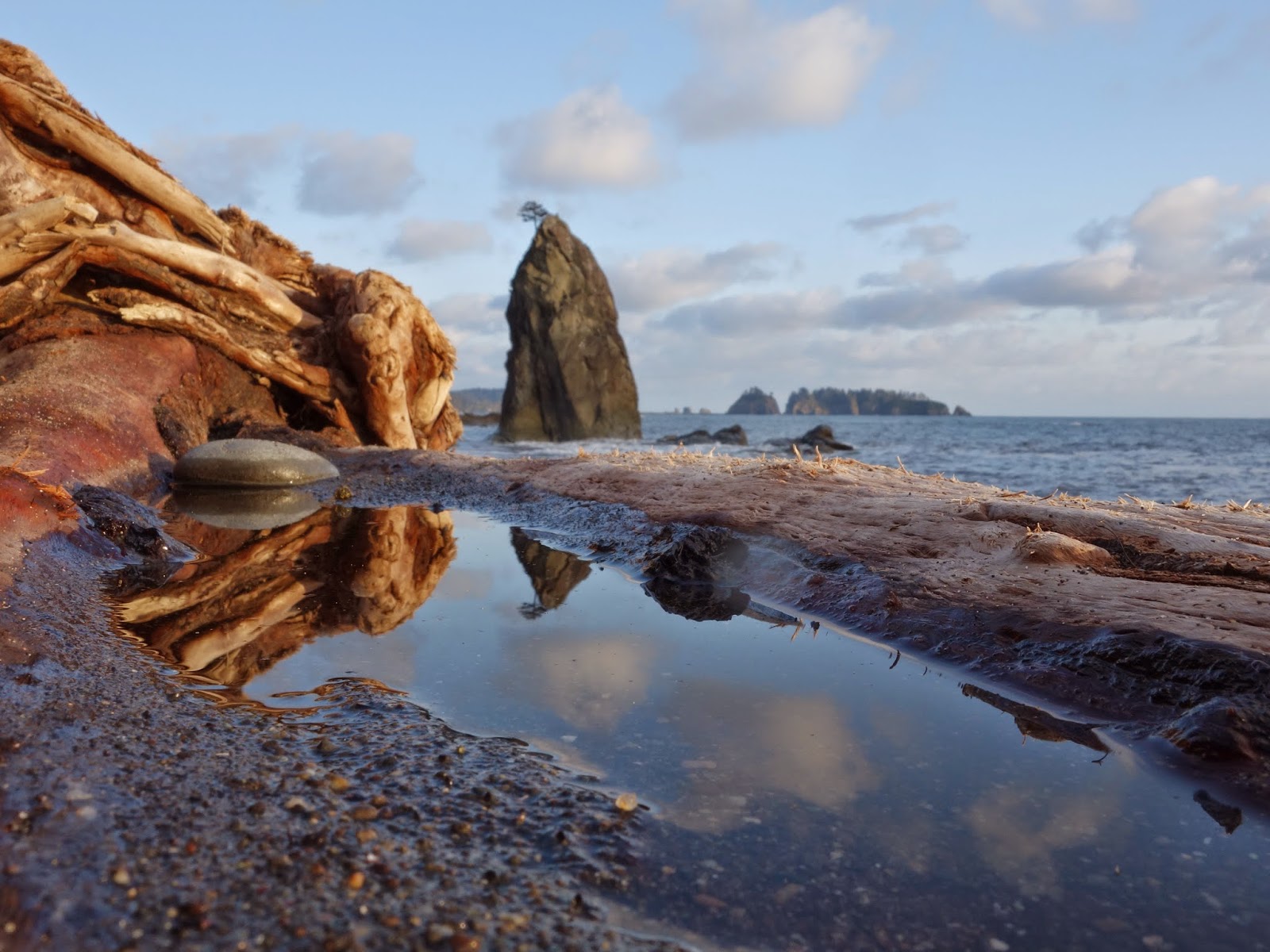 |
| Great place for a tilting lens board! |
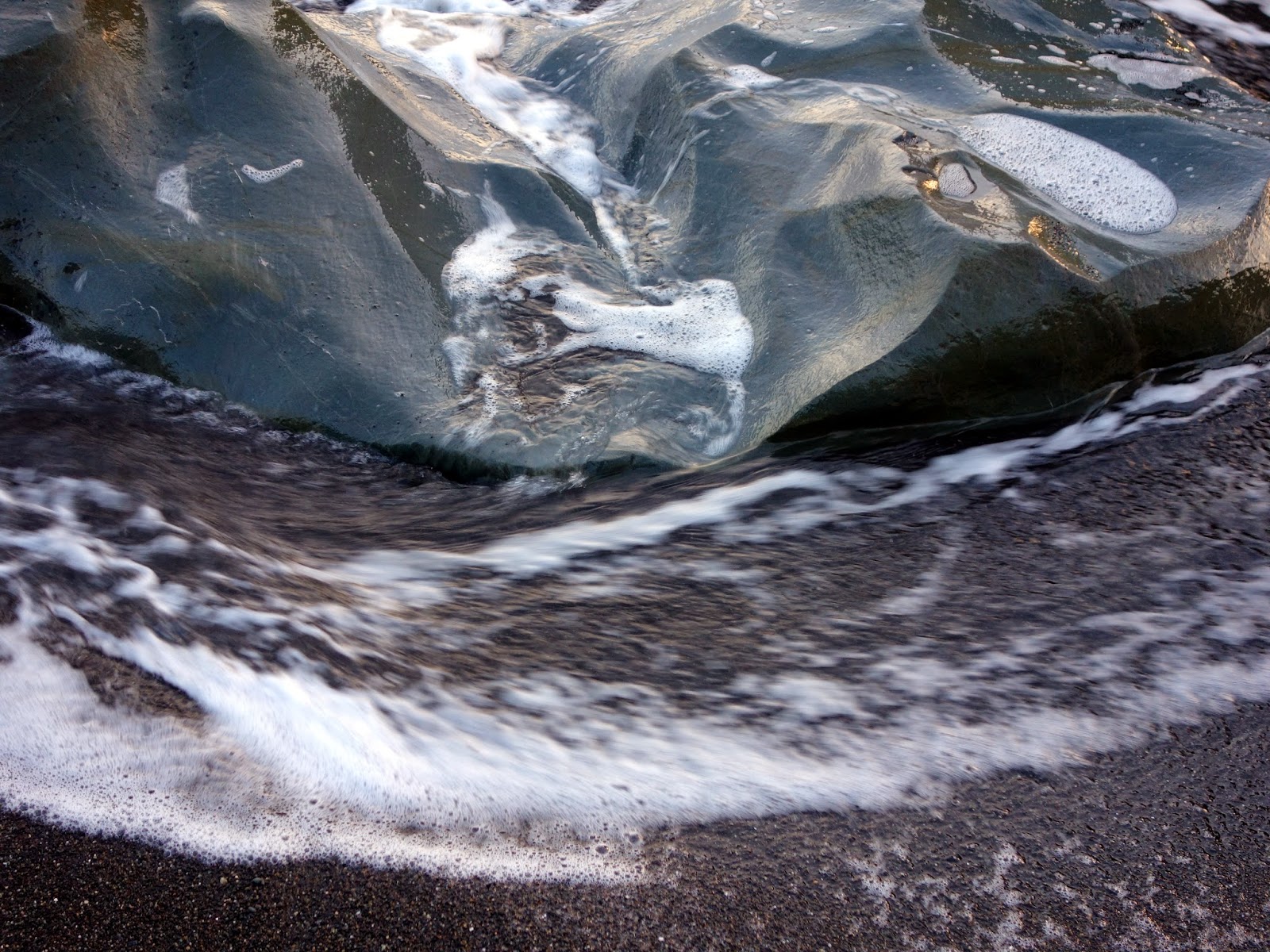 |
| Motion, stability and texture all in one? Really. |
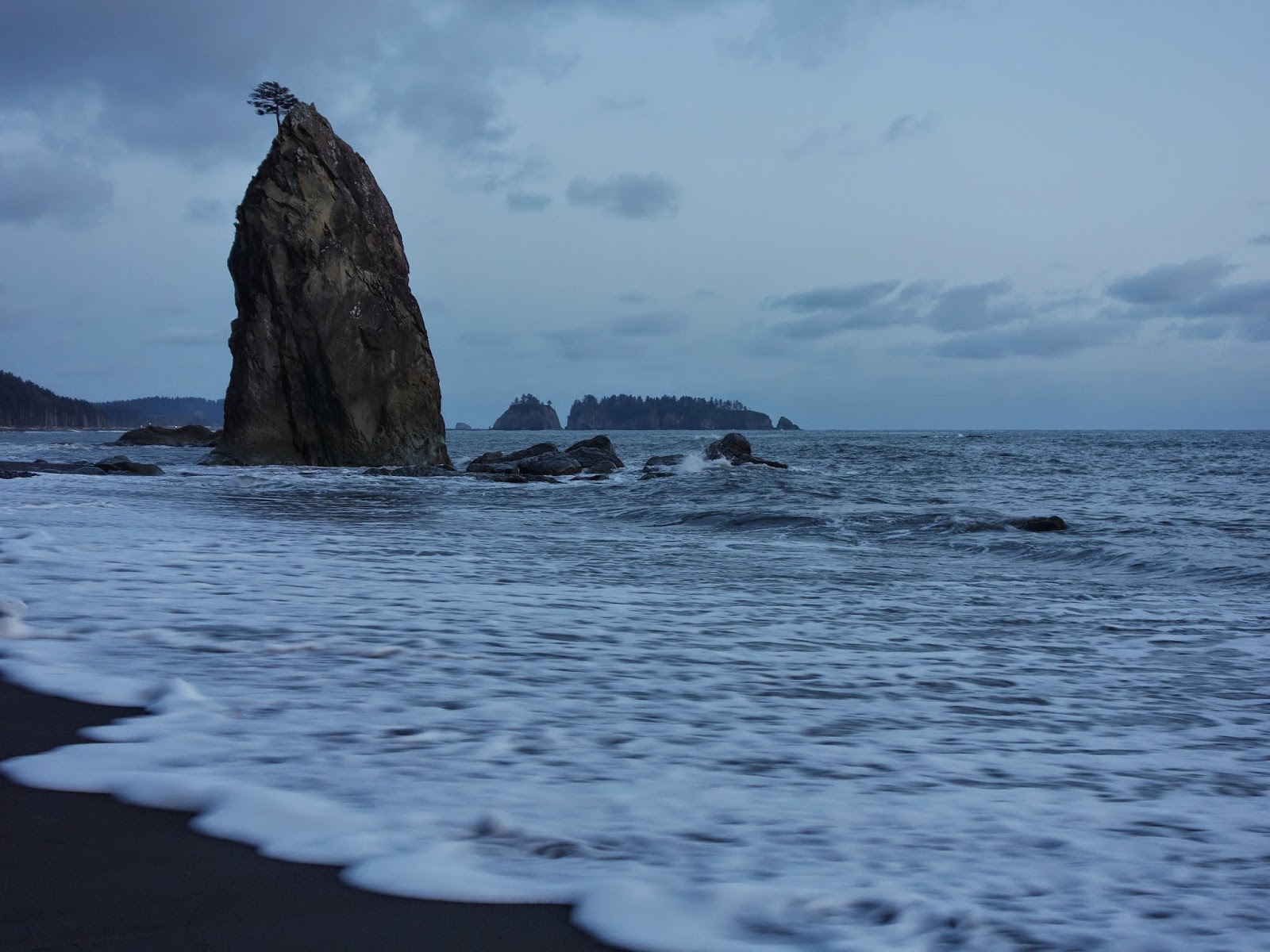 |
| Yes, so many photographers shot this hunk of rock, that if it lost a bit of itself from having its photo taken, this would be just a flaccid lump today. You don't even have to hike two miles to get here. |
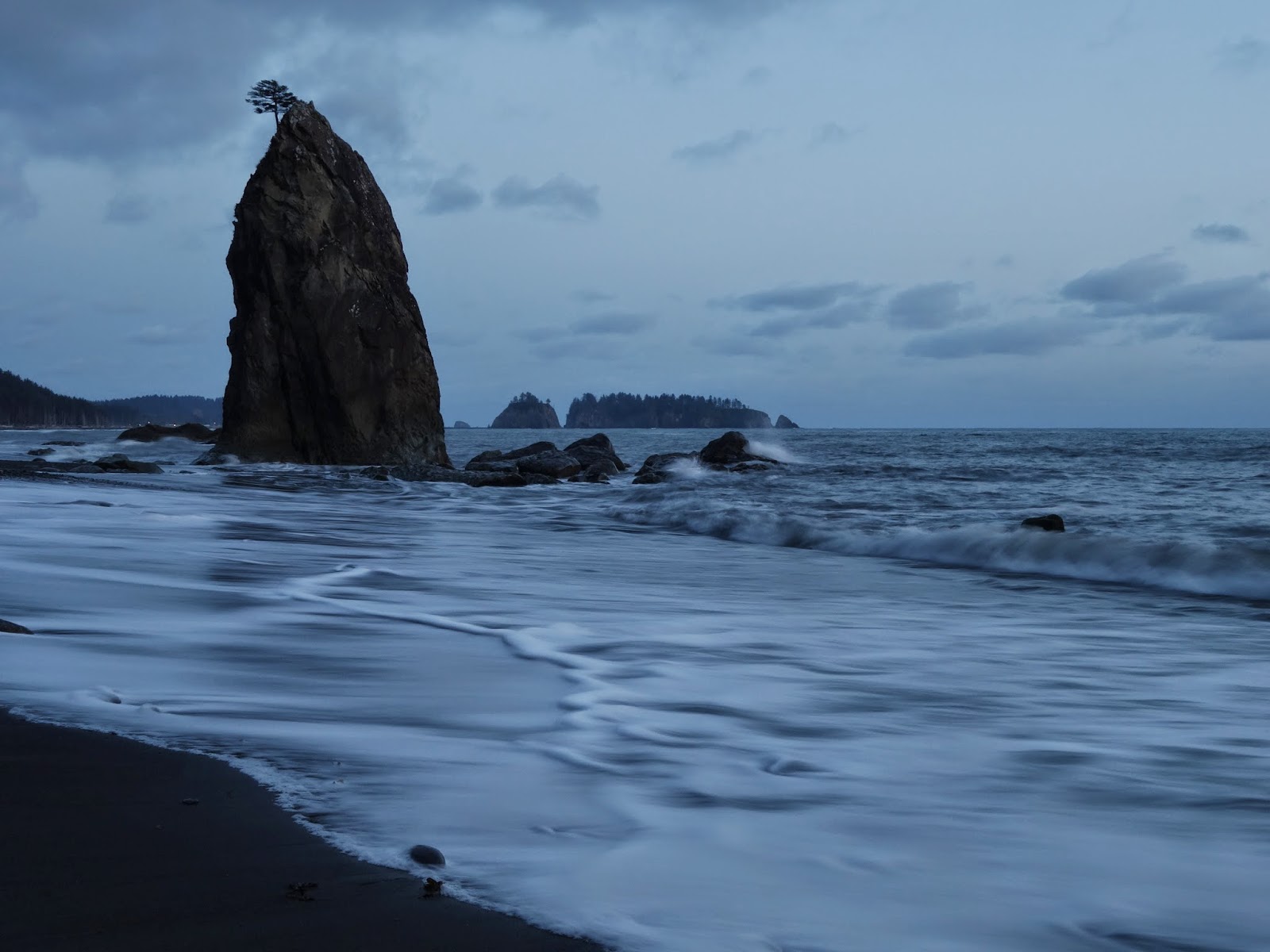 |
The sun had pretty much dropped beyond the horizon. The camera meter took over exposure times |
No! Not again!! Yes, again. When at home viewing shots on my computer, I let Picasa do the hard work. Yes, free software from Google, perfect for pictures shot with a little Sony camera. The picture could use some more pimping--I just haven't learned that part yet.
On the next morning, I broke camp and walked further up the coast, traveling over soft sand, rocks, boulders and logs, again at high tide, taking two hours under changing skies to make 2 miles, bringing me to the Chilean Memorial, near where a schooner and crew of that nation went to Davy Jones' locker. The memorial, a metal plaque mounted on a boneyard style headstone, sat on the beach, visible to anyone looking for it, with a few shrubs in front. Getting a closer look I discovered stinging nettle. The park service ranger who arrived confirmed the loss of the only campsite to a mudslide. Recalling a forecast of rain for the next day, I turned back. A little water makes for dangerous, slippery travel over logs and mossy rock. As I walked back over the intertidal zone, my running shoes crushed small barnacles on the rocks on the way back to my camp at Hole in the Wall. I set up camp and read more of Jonathan Goldstein's Ladies and Gentlemen: the Bible.
A hiker with a large pack came from Cedar Creek (past the Chilean Memorial) bound for Rialto Beach. He started at Rialto Beach and had sprained his ankle causing him to delay his departure for two days. I forgot to ask if wet rocks or logs caused his mishap.
Evening brought more photographers, as part of a photo tour, and a few others shooting snaps. The photo tour students included people from Massachusetts, Iowa and Italy. Marc Adamus, said to have made the big time, led the tour. He walked among his attendees, giving tips--he didn't have his own gear with him. All stood in the water, getting cold and wet to the knees. I didn't think to ask: Why don't very many women shoot landscapes? No interest? What does it mean when a woman says, that's a beautiful photograph of that shore, forest, mountain, etc.? Maybe they don't want/need more than to see the place, without spending a king's ransom for the gear to capture the essence?
The final morning brought a fine mist, barely wetting the tarp. I cooked quinoa flakes with not enough cinnamon or sugar, packed my gear while under the tarp, took down the tarp and left for the car. Along the way, I saw flat enough areas for maybe a half dozen fine campsites, three of which I poked around. I like this place for a simple overnighter as well as for introducing a newbie to camping in the wilderness--a short hike, good campsites and many logs for firewood if one had the tools and desire to cut it. I stopped at the Three Rivers Fishing Resort for their World Famous River Burger--I Googled that and saw they captured the top three results. Someone knew their HTML coding. Someone else knew how to make tasty burgers and yummy onion rings.
Then the rain began, quietly at first, building slowly, and then, it fell hard, as if it had been crossing its legs for two days (it was two days since the last rain). Driving back to Aberdeen, I saw two women thumbing for a ride. They looked clean. Hailing from Belgium, one had worked as a ski instructor and the other as a painter in Vancouver, B.C. for two years, saving $ to travel. They had stayed in Seattle free for three nights, couch surfing. I drove them to the south end of Cosmopolis, where they hoped to hitch a ride to Astoria on southbound US 101. One took a group selfie for their Facebook page. I am now in positive balance by one for hitchhiking points.
Notes to self:
- add side pullouts to the tarp to improve interior space;
- try one less side guy-line, i.e. 4 corner guy-lines and 2 side guy-lines;
- maybe make the tarp 2' wider, (9x10 final) to improve headroom.
- Shock cord the tarp pole, please
- Check your water purification tabs before your next trip. Maybe buy a Sawyer mini, or not.
- You forgot the olive oil; it was on your checklist!
- add more spice to your food!
- You ate three pounds over 40 hours, good job. Eating by the clock wasn't so hard, was it? Next time, eat a little bit more.
- Frostline gaiters rode up back of right heel. Sew a loop on shoe heels and button on gaiter?
- Convert center release buckles on fleece shorts/legs to 20" separating zipper?
- Maybe make insulated arm warmers to replace fleece warmers?
Corresponding file names for the above photos: 640 652 694 695 702 713a 725 736 747b.
Sunday, April 27, 2014
Camping preparation
In preparation for camping, I made patterns from a pair of pants that fit generously, cutting the legs short just above the knees. I cut gray colored fleece and sewed the pieces together. A piece of waistband elastic completed the job. I made custom leg warmers from the same fleece, cutting the fabric without a seam allowance. I used a seam allowance of 3/8". I used some 3/4" webbing and a low profile center release buckle to attach each to the underside of shorts in the front of each leg.
Arm warmers also came together from lichen colored fleece.
I made a mitten pattern, producing one gray fleece mitten and a red fleece mitten. Easy fitting mittens, but the next pair must have palm grips, mitten hooks and different color tops and palms.
I walked downtown with backpack and shorts, legwarmers and arm warmers. The arm warmers need a 3" extension at the top end. Leg warmers worked well, and fit well, though a little tight getting on and off over my heel.
The Rayway backpack needs a proper closure for the top, maybe roll top and also needs a frame so that it can carry loads up to 30#. It also needs a softer padding in the shoulder straps. Grab loops on the shoulder straps and maybe even sternum straps.
The north section of the Olympic NP Northwest Coast Trail beckons. Too many appointments this week. Have to cancel at least one!
Arm warmers also came together from lichen colored fleece.
I made a mitten pattern, producing one gray fleece mitten and a red fleece mitten. Easy fitting mittens, but the next pair must have palm grips, mitten hooks and different color tops and palms.
I walked downtown with backpack and shorts, legwarmers and arm warmers. The arm warmers need a 3" extension at the top end. Leg warmers worked well, and fit well, though a little tight getting on and off over my heel.
The Rayway backpack needs a proper closure for the top, maybe roll top and also needs a frame so that it can carry loads up to 30#. It also needs a softer padding in the shoulder straps. Grab loops on the shoulder straps and maybe even sternum straps.
The north section of the Olympic NP Northwest Coast Trail beckons. Too many appointments this week. Have to cancel at least one!
Subscribe to:
Comments (Atom)